

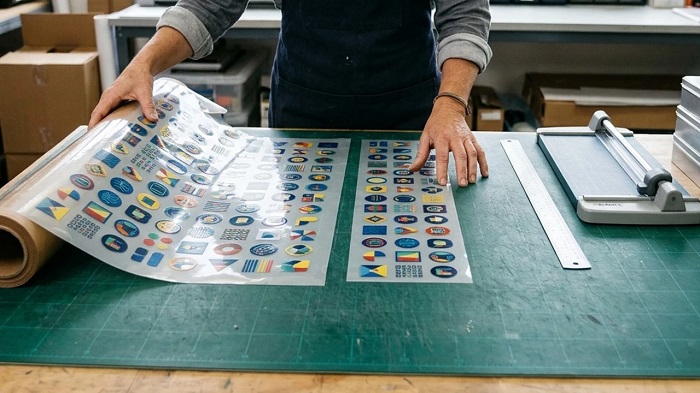
When commercial print shops compare a 60 cm wide-format roll-to-roll UV DTF (ultraviolet direct-to-film) printer against a compact 42 cm or 45 cm machine, the financial crossover depends on weekly nested gang-sheet area, unprinted margin waste percentage, and urgent B2B rush-order density: a 60 cm platform lowers film waste along roll edges and packs more multi-SKU emblems per linear metre, whereas a 42 cm system offers a smaller floor footprint and lower initial roll inventory for shops running lighter weekly volumes.
For promotional product decorators, trade-show gift suppliers, and packaging print shops, sizing roll width to actual order patterns prevents both under-powered rush bottlenecks and idle wide-format media rolls.
Why Roll Width Changes Film Utilization Efficiency on Nested Gang Sheets
Every roll-to-roll UV DTF printer requires fixed unprinted side margins along the left and right edges of the A-film so pinch rollers, media edge guards, and inline lamination tension remain stable. While a 15 mm to 20 mm side margin looks minor on paper, its impact on usable print area differs noticeably between narrow and wide media rolls:
- Higher net usable width ratio on 60 cm media: When fixed pinch-roller margins are subtracted from a 60 cm roll versus a 42 cm roll, the 60 cm web dedicates a higher percentage of total film purchased to active revenue-generating graphics.
- Better nesting geometry for wider packaging decals: If a corporate gift client orders 18 cm wide presentation-box lid crests, a 42 cm usable print zone can only fit two crests across with a wide unprinted strip left empty, whereas a 60 cm roll nests three crests side by side across the full width.
- Fewer roll changeovers during 48-hour B2B rush runs: When fulfilling a five-hundred-piece conference kit containing tumblers, notebook covers, and pen boxes, a 60 cm multi-head machine outputs the entire nested batch in fewer linear metres and fewer roll reloads.
Comparing 42 cm / 45 cm and 60 cm Roll-to-Roll UV DTF Platforms
Before choosing a machine frame size, shop owners should evaluate how media width interacts with printhead count, floor space, and weekly film turnover.
| Selection Dimension | Compact 42 cm / 45 cm Roll-to-Roll UV DTF Line | Wide-Format 60 cm Roll-to-Roll UV DTF Line | Commercial Sizing Rule |
|---|---|---|---|
| Nesting efficiency across mixed sizes | Ideal for small chest-badge sized logos (3–8 cm) and narrow bottle strips | Fits wide box-lid graphics (15–25 cm) alongside small filler logos with minimal edge waste | Choose 60 cm if orders frequently mix large packaging panels with small promotional emblems |
| Printhead architecture & speed tier | Typically 2-head to 3-head configurations balanced for moderate daily runs | Supports 3-head and 4-head industrial arrays for simultaneous white, colour, and high-build varnish | Choose 60 cm 4-head architecture when 24-to-48-hour B2B event deadlines dominate the schedule |
| Consumable roll shelf life & turnover | Lower per-roll outlay; easier to consume a full A/B film roll quickly on light weekly demand | Larger roll square metreage; requires steady weekly demand so opened rolls do not sit exposed to dust/humidity | Match roll width to a volume you can turn over cleanly within your climate-controlled storage window |
| Floor footprint & electrical setup | Fits tight retail backrooms and compact sign bays | Requires full industrial aisle clearance for heavy 60 cm media roll loading and unloading | Measure doorway width and operator roll-loading clearance before ordering a 60 cm frame |
Managing Roll Turnover and Rush-Order Scheduling
A common misconception among first-time buyers is that buying the widest machine on the market automatically guarantees the lowest cost per decal. In reality, a 60 cm UV DTF printer delivers its unit-cost advantage only when the shop’s weekly order stream fills the width of the gang sheet and consumes opened A/B film rolls at a steady pace.
If a shop only prints two linear metres of stickers once a week and leaves an opened 60 cm roll sitting on the spindle in an unconditioned room, edge dust and ambient moisture absorption on the exposed film can offset any nesting savings. Conversely, shops that aggregate daily trade-show, corporate gifting, and local trade orders into tightly packed 60 cm gang sheets achieve both fast turnaround and minimal border trim waste.
Selecting Industrial 42 cm to 60 cm UV DTF Printers From a Unified Lineup
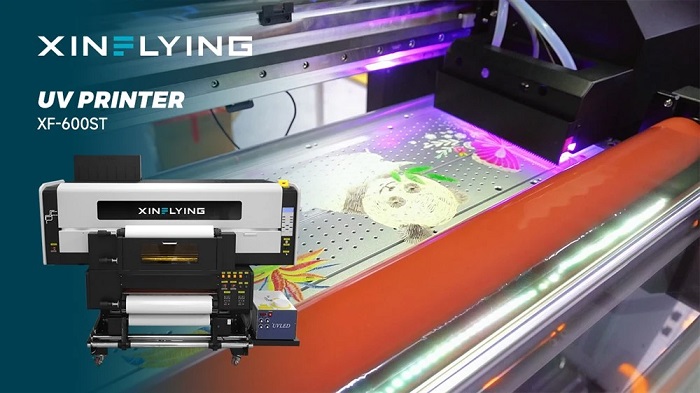
Evaluating both width classes inside the same manufacturer family makes it easier for print shops to compare frame footprints, printhead configurations, and inline lamination mechanics on an apples-to-apples basis. Production managers comparing wide 60 cm platforms such as the XINFLYING XF-600st and XF-600S against compact models like the XF-420S, XF-420st, and XF-450S can review the complete specifications across UV DTF printers from XINFLYING to align roll width and head count with their order book.
Whether a shop deploys a compact 42 cm unit for boutique daily runs or installs a 60 cm industrial system like the XINFLYING XF-600st for high-density B2B packaging and promotional gang sheets, matching media width to real weekly metreage keeps consumable utilization high and delivery lead times short.