

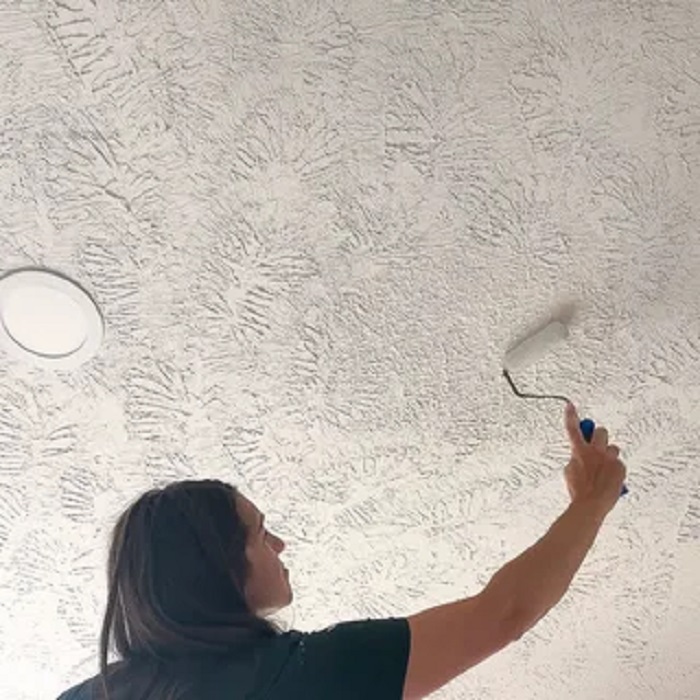
Painting the ceiling is one of the most noticeable stages of an interior renovation: a smooth, matte surface visually lifts the room, and preparation errors are immediately noticeable in sidelight. To ensure a professional-looking result, it’s important to follow the correct sequence of steps and pay attention to details—from choosing a roller to proper drying.
Preparing the ceiling before painting
Quality of preparation determines 80% of the result. Even expensive paint won’t hide defects if the substrate is loose, cracked, or has greasy stains.
Cleaning and Assessing the Substrate
- Remove peeling whitewash, old paint, and loose layers with a putty knife; if necessary, use warm water, a sponge, and soaking time.
- Degrease stains (kitchen areas, nicotine stains) and treat moldy areas with a specialized product; Mold is often caused by moisture and poor ventilation.
- Check the surface with side light or a flashlight: this will reveal any bumps, pits, and ripples.
Putty, sanding, priming
- Open cracks, remove dust, and prime problem areas.
- Seal cracks and seams; If necessary, use reinforcing tape.
- Apply the finishing filler in thin layers to achieve a uniform texture.
- Sand the surface (select a grit size appropriate for the material), then thoroughly remove dust.
- Prime the ceiling completely: the primer evens out the absorbency and reduces the risk of stains.
Tip: If the ceiling is very chalky (leaving a white mark on the palm of your hand), without a primer, the paint may form in patches and begin to peel.
Assessing the condition of the substrate: cracks, stains, whitewash, and peeling
Before painting the ceiling, inspect the substrate under good side lighting: this will reveal microcracks, filler waves, peeling, and traces of old coatings. Any paint will reproduce defects and won’t solve the problem if the underlying surface is weak or dirty.
Checking the condition involves looking for the root cause, not just cosmetic issues: cracks are often due to movement and shrinkage, stains are due to leaks or soot, whitewash has poor adhesion, and peeling is due to poor preparation or moisture. The goal is to restore the ceiling to a strong, dry, clean, and level base.
What to look for and what it means
- Cracks: hairline, opening cracks, along slab/drywall seams. It’s important to determine whether the crack is still present (whether there’s any movement or opening) and how deep it is.
- Stains: yellow streaks from leaks, gray-black marks (soot), reddish spots (rust), dark spots (mold). Any stain indicates contamination or a moisture source.
- Whitewash (chalk/lime): easily smears, creates dust, and is washed away by water. Paint usually adheres poorly to whitewash and may peel off in layers.
- Delamination: “bubbles,” peeling, and separation of putty/paint from the base. Weak layers must be removed to the solid base.
- Assess the strength: run a spatula over questionable areas, tap – a dull sound and crumbling indicate delamination.
- Check for dust: wipe with your palm or a dry cloth – if a white mark (whitewash/dust) remains, the base requires removing the weak layer and priming.
- Identify damp areas: stains from leaks, dark spots, dampness. Painting can only be done after the cause has been eliminated and the surface has completely dried.
- Detect biological damage: if mold is suspected, treat the area and eliminate the source of moisture (ventilation, insulation, leaks).
Bottom line: high-quality painting begins with proper diagnostics. Cracks require pointing and repair, stains require removal of the cause and insulation, whitewash must be removed, and peeling must be sanded down to a solid layer. The better the substrate is prepared (strong, dry, clean, and primed), the smoother the paint will adhere and the longer the coating will last.